Explore our high-performance engineered magnetic components, manufactured to precise physical specifications for global industrial application portfolios.
Founded at the turn of the millennium in 1999, Zhejiang Laysun Magnetics Ltd. has evolved from a visionary enterprise to a globally recognized national high-tech manufacturing leader specializing in high-performance permanent rare earth NdFeB magnets. Spanning over an extensive production footprint, we combine direct access to Chinese upstream mining resources with deep powder metallurgy expertise.
Our dedicated team of over 300 engineering and production specialists operates our advanced facility to deliver custom solutions for electric vehicles, high-speed rail motors, wind energy generators, industrial automation, and consumer electronics.
As an industry leader, our development and quality programs are backed by rigorous adherence to international standards, providing key OEMs and Tier-1 suppliers across Europe, the Americas, and Asia with unmatched stability, quality, and technical support.
An in-depth look into the microstructural parameters, energy products, and performance characteristics of advanced permanent magnets.
The industrial dominance of rare earth permanent magnets, specifically Neodymium-Iron-Boron (NdFeB) and Samarium-Cobalt (SmCo), stems directly from the intrinsic electron configuration of lanthanide elements. These metals possess unfilled 4f electron shells, which yield highly localized and uncompensated spin moments. When coupled with an anisotropic crystalline structure, these elements display exceptional magnetic properties characterized by high magnetic remanence ($B_r$), high intrinsic coercivity ($H_{cj}$), and unparalleled maximum energy products ($(BH)_{max}$).
Remanence represents the magnetic induction remaining in a saturated magnetic material after the external magnetizing field is removed. In sintered NdFeB magnets, the $B_r$ can reach up to 1.5 Tesla (15,000 Gauss) in specialized N54 and N56 grades. This high flux density is critical for generating strong torque in space-constrained industrial motors and electric vehicle powertrains.
Intrinsic Coercivity ($H_{cj}$) is the measure of a material's resistance to demagnetization. Rare earth magnets exhibit high crystal field anisotropy, which locks the spin orientation along a specific crystallographic axis (the "easy" axis). Heavy rare earth elements, specifically Dysprosium (Dy) and Terbium (Tb), are commonly diffused into the grain boundaries of Nd2Fe14B to dramatically elevate $H_{cj}$. This ensures the magnet retains its polarization under high demagnetizing fields and temperatures up to 220°C (typical in EV traction motors).
Calculated as the maximum product of magnetic induction ($B$) and magnetic field strength ($H$) in the second quadrant of the hysteresis loop, $(BH)_{max}$ defines the total energy stored per unit volume of the magnet. Our high-grade sintered NdFeB exhibits $(BH)_{max}$ values up to 55 MGOe (approx. 438 kJ/m³), allowing engineers to minimize the size and weight of key rotary and linear actuators.
| Magnet Grade (Sintered NdFeB) | Remanence B_r (T) | Coercivity H_cb (kA/m) | Intrinsic Coercivity H_cj (kA/m) | Max Energy Product (BH)_max (kJ/m³) | Max Operating Temp (°C) |
|---|---|---|---|---|---|
| N52 | 1.43 - 1.48 | ≥ 820 | ≥ 875 | 398 - 422 (50-53 MGOe) | 80 |
| 48SH | 1.37 - 1.43 | ≥ 1011 | ≥ 1592 | 366 - 390 (46-49 MGOe) | 150 |
| 42UH | 1.28 - 1.34 | ≥ 971 | ≥ 1989 | 318 - 342 (40-43 MGOe) | 180 |
| 38EH | 1.22 - 1.28 | ≥ 923 | ≥ 2387 | 287 - 310 (36-39 MGOe) | 200 |
| 35AH | 1.17 - 1.23 | ≥ 868 | ≥ 2785 | 263 - 287 (33-36 MGOe) | 220 |
Navigating volatile raw material dynamics, technical verification cycles, and strategic buffer stock allocation.
In modern industrial procurement, rare earth magnets are treated as highly strategic components. Because the market value of key raw materials—namely Praseodymium-Neodymium (PrNd) metal, Dysprosium (Dy), and Terbium (Tb)—is subject to supply chain imbalances, international buyers prioritize manufacturers that offer transparent, index-based pricing formulas linked directly to metal market indices (such as Asian Metal or SMM).
Furthermore, procurement departments must satisfy strict global standards, including RoHS, REACH, and Dodd-Frank conflict minerals regulations. Zhejiang Laysun Magnetics Ltd. provides complete material traceability starting from upstream separation facilities. This level of supply chain security mitigates the regulatory and reputational risks associated with sourcing components for high-profile green technologies.
We provide long-term contract structures that peg pricing to transparent rare earth oxide indices, protecting buyers from market volatility.
Full documentation of mineral pathways, ensuring compliance with global supply chain security acts and environmental regulations.
Dedicated warehouse stocks and localized safety inventories to guarantee consistent, uninterrupted delivery for assembly lines.
Tailored engineering and geometry optimization across diverse global technological sectors.
Modern EV traction motors demand ultra-high coercivity to withstand temperatures upwards of 180°C and intense demagnetizing stator fields. We design customized sintered NdFeB blocks with segmented geometries and advanced coatings to mitigate eddy current losses, maximizing vehicle range and power density.
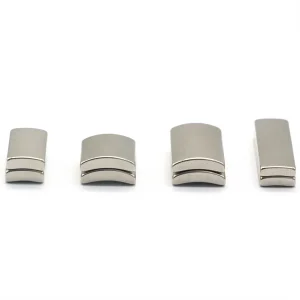
Offshore wind turbines utilize direct-drive permanent magnet generators to minimize maintenance requirements. Our heavy-duty NdFeB arc segments are optimized for extreme corrosion resistance and mechanical integrity, guaranteeing continuous power generation over a 25-year service life in marine environments.
High-torque servo motors require precise flux profiles and minimal cogging torque. We supply high-precision ring and cylinder magnets with tight dimensional tolerances (down to +/- 0.05 mm) and multi-pole orientation, enabling smooth, accurate robotic limb movement.
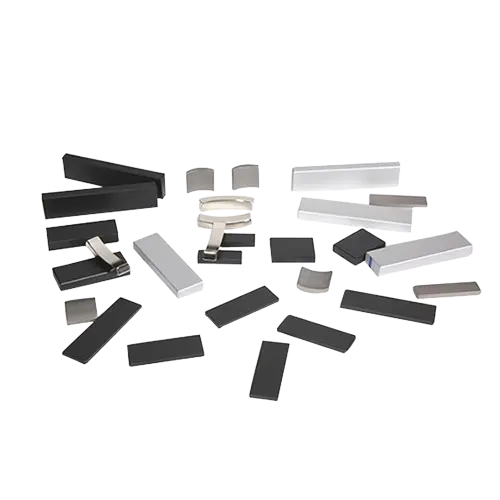
Pushing the physical boundaries of rare earth metallurgy through grain boundary engineering.
The roadmap for permanent magnets is driven by two parallel goals: reducing dependence on scarce heavy rare earth elements (HREEs) and increasing maximum operating temperatures. As a leading manufacturer, Zhejiang Laysun Magnetics Ltd. is actively scaling two breakthrough technologies:
Aligning mass production with international quality standards, certification systems, and logistics.
Zhejiang Laysun Magnetics Ltd. operates a modern 100,000 m² factory equipped with vacuum induction melting furnaces, hydrogen decrepitation units, jet milling systems, and isostatic pressing machines. This automated setup enables us to maintain an annual output of 5,000 tons, ensuring stable delivery and competitive lead times.
Our quality control laboratories are outfitted with automated magnetic property testing systems, environmental simulation chambers, and salt-spray testing equipment. This guarantees that every production batch matches your performance specifications, whether for high-volume automotive runs or custom, tight-tolerance scientific projects.
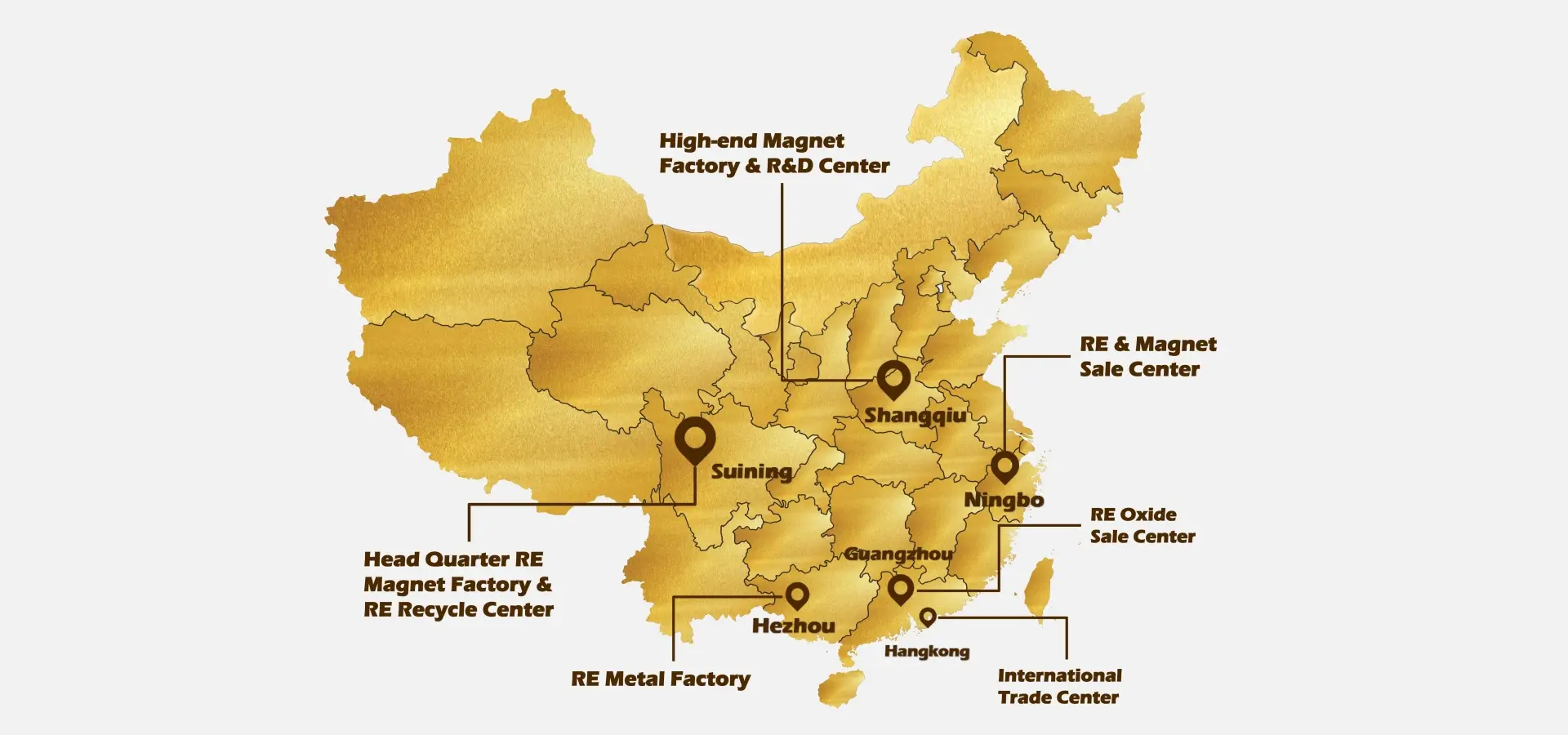
Helping our international partners navigate local compliance, safety certifications, and logistics.
To support global supply chains, we provide technical and engineering assistance across our target markets. Our engineers assist clients during the design phase with finite element magnetic modeling (FEA) to determine optimal material grades and custom geometries.
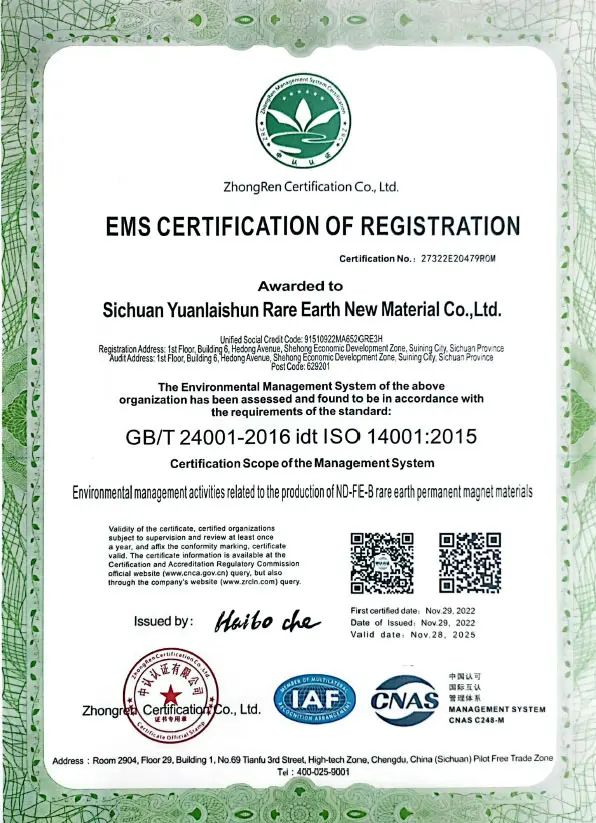
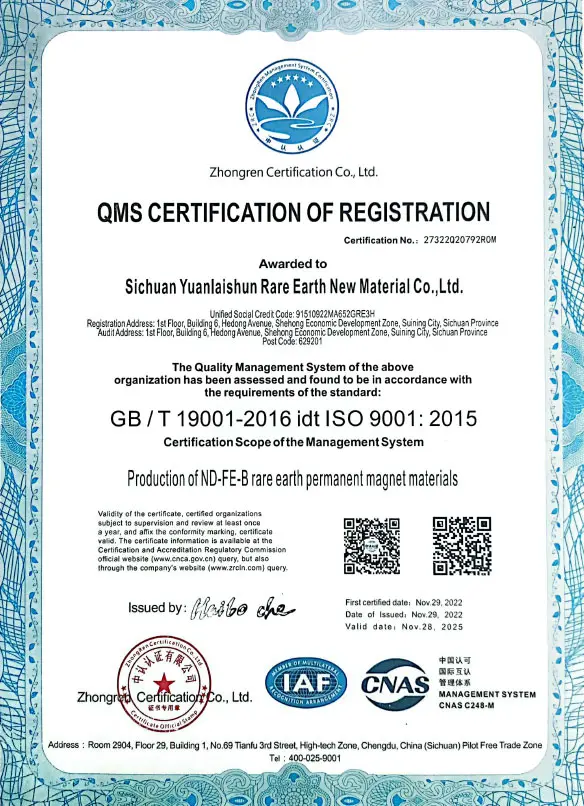
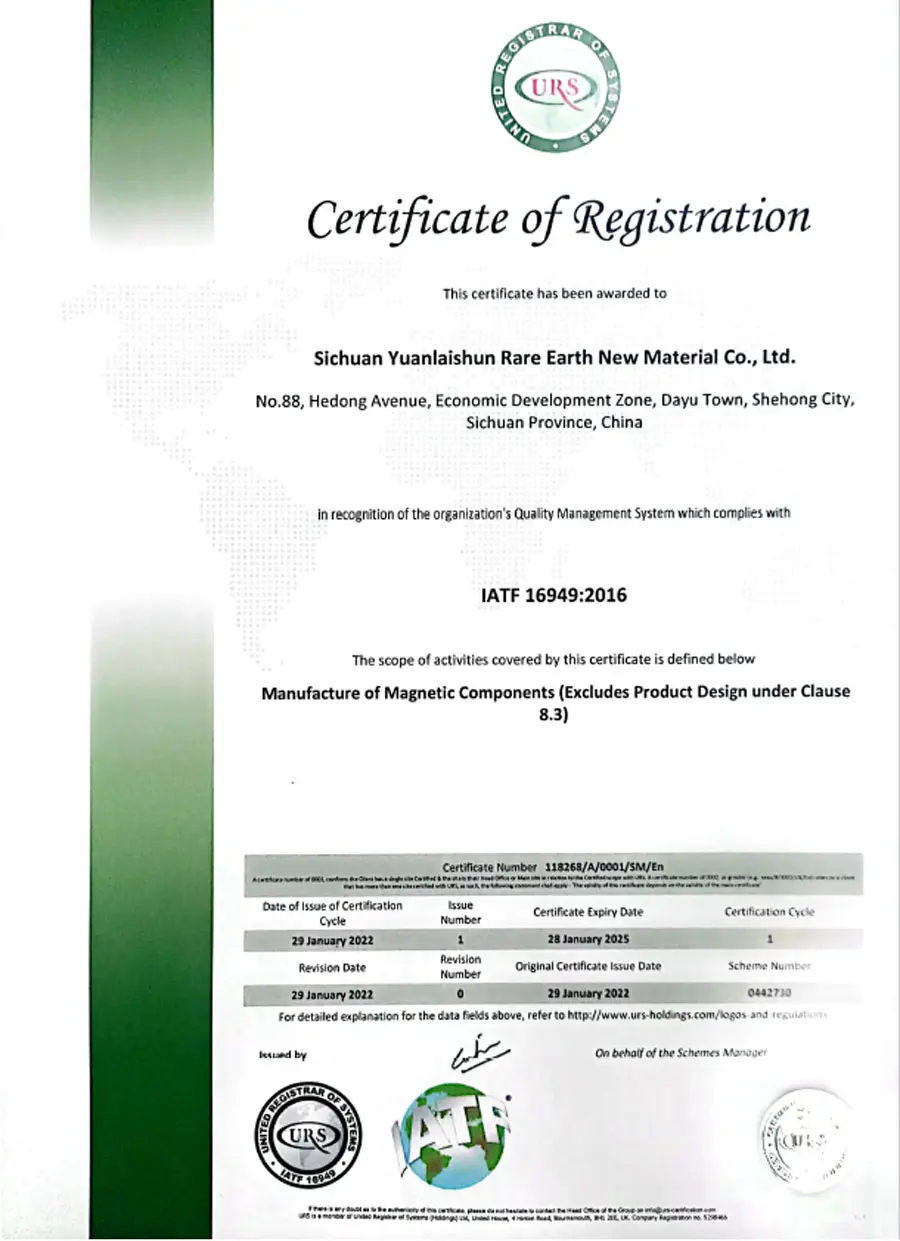
On the regulatory front, our operations are certified under ISO 9001:2015, ISO 14001:2015, and ISO 45001:2018. We support IATF 16949 requirements for automotive customers, offering complete PPAP documentation and strict control over manufacturing processes.
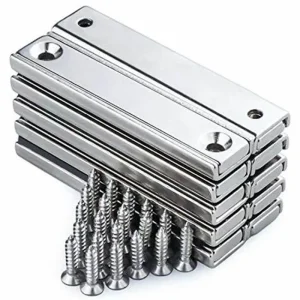
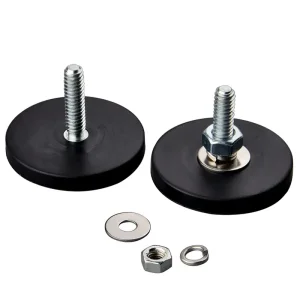
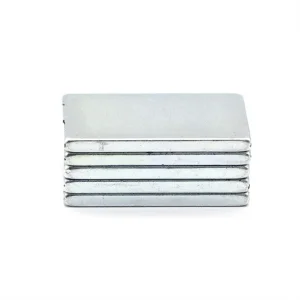
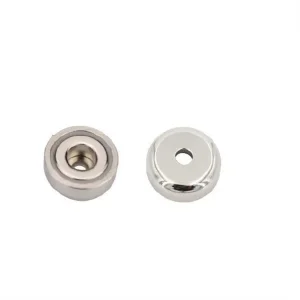
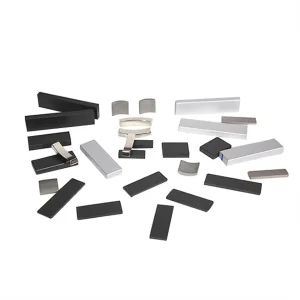
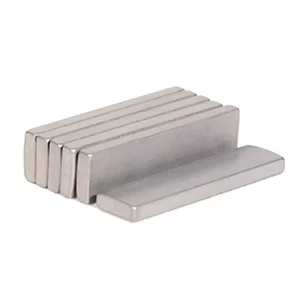
Select specialized permanent magnets configured for heavy machinery, automotive EPS, high-precision electronics, and power tools.
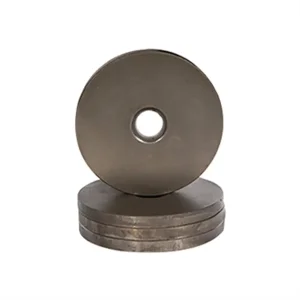
Key technical explanations covering magnetic behavior, temperature stability, and structural design choices.
Hcb (magnetic coercivity) is the external reverse magnetic field required to reduce the total magnetic induction (B) to zero. In contrast, Hcj (intrinsic coercivity) is the reverse magnetic field required to reduce the material's intrinsic magnetization (M) to zero. For rare earth magnets, Hcj is always higher than Hcb, making it the key metric for determining how well a magnet resists demagnetization in high-temperature or high-reverse-field environments.
Sintered NdFeB magnets experience drop-offs in magnetic performance as temperatures rise. This is measured by the temperature coefficient of remanence (α) and coercivity (β). Standard N-grade magnets are rated to 80°C. For higher temperatures, we add Heavy Rare Earth Elements (HREEs) like Dysprosium (Dy) or Terbium (Tb) to produce SH, UH, EH, or AH grades, which can operate at temperatures up to 220°C.
Since NdFeB magnets contain a high iron content, they are susceptible to oxidation. We offer several protective coatings: Nickel-Copper-Nickel (NiCuNi), Zinc (Zn), Epoxy resin, Gold, and specialized polymer or rubber jackets. For marine and wind turbine applications, we apply multilayer epoxy or passivated coatings that pass 48-to-96-hour salt spray testing.
Grain Boundary Diffusion (GBD) is an advanced manufacturing technique where Dysprosium (Dy) or Terbium (Tb) is applied to the surface of a sintered magnet and diffused into the grain boundary structure via heat treatment. This process places the heavy rare earth elements exactly where they are needed to resist demagnetization, increasing coercivity with minimal reduction in remanence (Br) and lowering raw material costs.
 Laysun Magnetics