Global buyers are examining Ndfeb Magnet Applications with sharper technical expectations. These magnets power electric vehicle motors, wind turbine generators, hard disk drives, speakers, sensors, magnetic separators, and compact medical equipment. Their strength is impressive. Their limitations matter just as much.
Masato Sagawa, a pioneer of neodymium magnet development, described the discovery of NdFeB magnets as “a lucky accident.” That observation still carries practical meaning. Powerful materials often create new opportunities, but careful engineering determines commercial value. Buyers should match magnet grade, shape, coating, operating temperature, and tolerance to the final device. A thin nickel-copper-nickel coating may suit indoor electronics, while harsher environments can require stronger corrosion protection. Poor selection can cause surface damage, magnetic loss, or early failure.
Reliable sourcing requires more than comparing prices. Experienced purchasing teams review test reports, dimensional drawings, magnetic performance data, and batch consistency. They also check whether suppliers can maintain quality across prototypes and larger production runs. Standards and documentation should be verified for the destination market. Traceability helps when a shipment contains unexpected variation.
The strongest magnet is not always the best magnet. This is easy to forget. A lower-grade option may reduce cost, improve temperature stability, or simplify assembly. Global buyers should also consider machining risks, safety procedures, packaging, and lead times before approval. Some decisions remain uncertain without real operating data. That is where prototype testing becomes valuable. It exposes assumptions early, although it cannot remove every supply-chain risk. An informed approach makes Ndfeb Magnet Applications more dependable, practical, and commercially sustainable.
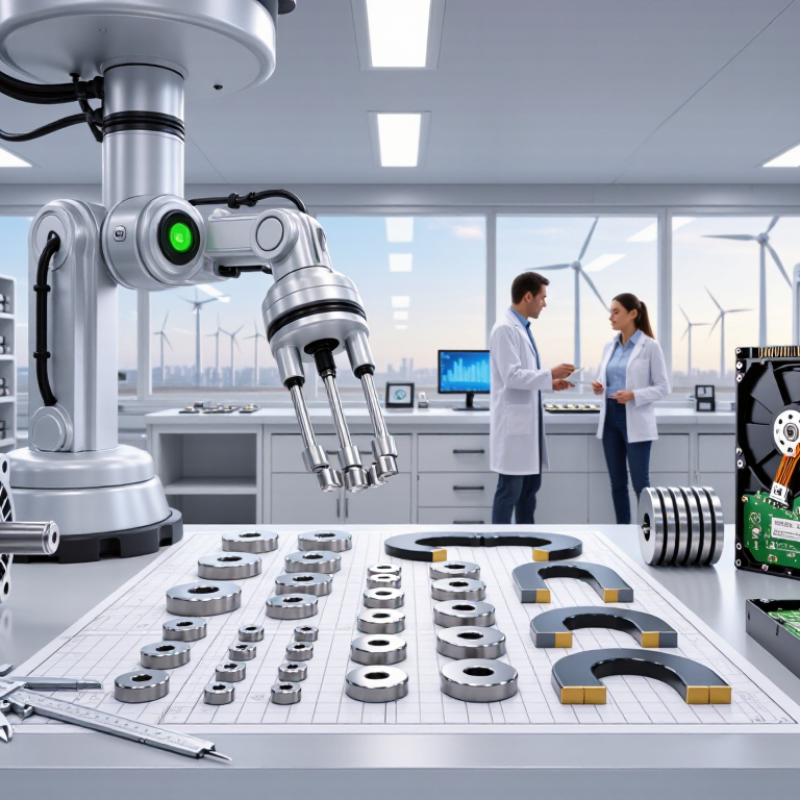
EV Traction Motors: 1–2 kg per Vehicle (IEA, 2024)
Electric vehicle traction motors are a major application for high-performance NdFeB magnets. Using the IEA’s 2024 estimate, one vehicle may contain 1–2 kilograms of permanent magnet material. That range matters. The IEA also expects global electric car sales to exceed 17 million units in 2024. At that volume, motor magnets could represent roughly 17,000–34,000 tonnes annually, before accounting for other applications.
Most traction motors use sintered NdFeB magnets inside the rotor. These magnets must withstand heat, vibration, and repeated acceleration cycles. Buyers should check remanence, coercivity, maximum operating temperature, dimensional tolerance, and corrosion protection. A small coating defect can become a serious field failure. Practical inspection should include magnetic testing, visual checks, batch traceability, and sampling after thermal exposure.
The 1–2 kilogram figure is useful, but not universal. Motor architecture, vehicle size, magnet design, and rare-earth content can change the actual requirement. Some drive units reduce magnet volume through stronger grades or improved geometry. Others need additional material for high-temperature performance. This is where forecasts become imperfect. The U.S. Department of Energy’s Critical Materials Assessment also highlights supply risks for rare-earth magnet materials, making verified sourcing and stable specifications increasingly important for global procurement teams.
| Application | Typical Motor Architecture | NdFeB Magnet Function | Indicative Magnet Demand | Why It Matters to Buyers | Key Purchasing Considerations |
|---|---|---|---|---|---|
| Battery-electric vehicle traction motors | Permanent-magnet synchronous motor, commonly used in high-efficiency traction systems. | Creates the rotor magnetic field that produces torque and supports high power density. | About 1–2 kg per vehicle | Traction motors are the principal automotive application highlighted in the IEA 2024 estimate and can influence vehicle efficiency, acceleration, and driving range. | Specify magnetic grade, operating-temperature capability, corrosion protection, dimensional tolerances, coating system, and batch-level inspection requirements. |
| Hybrid and plug-in hybrid traction motors | Compact permanent-magnet motor integrated with an internal-combustion powertrain and power electronics. | Provides high torque from a relatively compact motor during launch, acceleration, and regenerative braking. | Configuration-dependent; typically below or within the vehicle-level traction-motor range. | Hybrid platforms may use smaller motors than battery-electric vehicles, but production volumes can create significant recurring magnet demand. | Confirm rotor temperature limits, resistance to demagnetization, high-speed mechanical integrity, and supply continuity for multi-year programs. |
| Integrated e-axles | Combined traction motor, reduction gearing, and inverter in one compact drive unit. | Delivers high torque density while helping reduce the size and mass of the complete drive system. | Included within the vehicle’s traction-motor magnet requirement; not an additional vehicle-level quantity. | Integration increases the importance of magnet consistency because motor, gearbox, and inverter performance are engineered as one system. | Evaluate assembly compatibility, rotor balancing, magnet segmentation, adhesive performance, and traceability from raw material to finished component. |
| High-speed traction motors | High-rpm permanent-magnet motor designed to achieve compact packaging and high continuous power. | Maintains strong magnetic flux in a rotor operating under high centrifugal and thermal loads. | Part of the traction-motor estimate; quantity varies with motor size and rotor design. | Higher rotational speed can reduce motor size, but it increases demands on magnet mechanical retention and thermal stability. | Request high-temperature demagnetization data, mechanical retention specifications, rotor containment requirements, and dynamic-balance controls. |
| All-wheel-drive auxiliary traction units | Secondary electric motor added to provide additional axle torque or electronically controlled four-wheel drive. | Produces rapid torque response and efficient operation across changing road-load conditions. | Additional motor content depends on vehicle architecture; vehicle-level demand can exceed a single-motor design. | Multiple traction units can increase total magnet content and create separate specifications for front- and rear-axle motors. | Clarify whether the quoted mass is per magnet, per rotor, per motor, per axle, or per vehicle; avoid double-counting integrated drive units. |
| Regenerative-braking functions | Uses the traction motor as a generator during deceleration. | The same permanent magnets used for propulsion generate electrical energy during braking. | No separate magnet allocation; it uses the traction motor’s existing magnet assembly. | Magnet performance affects generator efficiency and the ability to recover energy during deceleration. | Assess thermal cycling, corrosion resistance, insulation compatibility, and long-term flux stability under repeated charge and discharge cycles. |
| Electric power-steering and thermal-management motors | Small permanent-magnet motors used in selected vehicle auxiliary systems. | Provides compact, efficient torque for steering assistance, pumps, fans, and compressors. | Small quantities per motor; aggregate demand depends on the number of auxiliary motors per vehicle. | These applications are lower-volume per unit than traction motors but can generate diversified demand across vehicle platforms. | Prioritize cost consistency, small-part dimensional accuracy, corrosion protection, automated inspection, and stable delivery of high-volume standard geometries. |
A typical estimate is 600–1,000 kilograms per megawatt. That estimate is not universal. Generator design, rotor diameter, and temperature can change the amount. Confirm whether packaging, fixtures, or segmented magnets are included.
They provide strong magnetic performance without multiple gearbox stages. This supports compact generator designs and stable power production. The magnetic assembly remains large. That can increase material, handling, and inspection demands.
Specify grade, dimensions, tolerances, coating, magnetization direction, and testing requirements. Request batch inspection records and temperature performance data. Small dimensional errors can delay assembly. A sample can fool you.
Permanent magnet rotors can provide high torque in compact motor frames. They may also support efficient variable-speed operation. Actual results depend on duty cycles, acceleration, cooling, and drive tuning. The magnet alone does not determine system efficiency.
No. The rating describes motor efficiency under defined conditions. Converter, cable, control, gearbox, and maintenance losses still matter. Check the complete motor-drive system. A well-rated motor may perform poorly beside a hot gearbox or poorly tuned drive.
Start with the required magnetic force and working air gap. N35 may suit many compact assemblies, while N52 offers stronger performance in limited space. Higher strength can increase cost, brittleness, and heat sensitivity. Measure the gap.
Request the rated operating temperature, irreversible loss data, and maximum exposure time. Motors and nearby coils may reach 150°C or more. Grades for 120–220°C operation often sacrifice some magnetic strength. Short tests can mislead. Heat changes everything.
Coating choice depends on humidity, chemicals, friction, and assembly pressure. Nickel-based coatings may suit general indoor use. Epoxy or specialized finishes may suit damp environments. Specify coating thickness, adhesion testing, salt-spray evidence, and dimensional tolerance. Inspect edges after pressing or impact testing. No coating is perfect.
Request material certificates, batch inspection records, temperature data, and representative samples. Confirm magnetization direction and actual dimensions. Check the full batch, not only one attractive sample. Documentation may be incomplete. I would challenge optimistic estimates before signing.
Ndfeb Magnet Applications span electric vehicles, renewable energy, industrial automation, and consumer electronics. In EV traction motors, each vehicle may use approximately 1–2 kg of NdFeB magnets to support compact, high-torque performance. Direct-drive wind generators can require about 600–1,000 kg of magnet material per megawatt, making magnetic selection an important factor in project cost, weight, and long-term reliability. Industrial servo motors also benefit from NdFeB magnets by enabling high power density and IE5 efficiency performance under IEC 60034-30-2.
For global buyers, selecting the right magnet requires more than comparing prices. Common grades range from N35 to N52, while operating-temperature ratings of 80–220°C should match the application’s thermal conditions. Appropriate coatings are also essential for protection against corrosion and environmental exposure. In consumer electronics, miniature NdFeB magnets support compact hard-disk drives, speakers, and other precision components. A complete purchasing decision should therefore consider magnetic strength, temperature resistance, dimensions, coating durability, consistency, and application-specific quality requirements.

 Laysun Magnetics